How AI Interview Scoring Works, What It Evaluates and Why Recruiters Use It
AI interview scoring uses AI interview software to evaluate candidate responses against job-specific competencies, skills, and role requirements to create structured, evidence-backed scorecards that improve consistency, reduce manual screening time, and help recruiters make more objective hiring decisions. This guide explains how AI interview scoring works, what it evaluates, its benefits and limitations, fairness considerations, and how AI interview software fits into high-volume recruitment.

Ankita Gupta
Marketing Specialist
A recruiter running fifteen first-round interviews a week is not going to remember candidate six as clearly as candidate fifteen. This is the exact gap that AI interview scoring was built to close.
AI interview scoring captures what a candidate actually says and scores it against the same job-specific criteria every time. It is the evaluation layer inside interview intelligence software, producing a structured, evidence-backed score instead of a fading impression. It doesn't replace the recruiter's judgment. It replaces the inconsistency that comes in once volume goes up.
Here's how the scoring actually happens, what it measures, where it fits in a hiring process, and the fairness questions worth asking before you roll it out.
What is AI Interview Scoring?
AI interview scoring is the use of AI interview software or AI hiring software to evaluate a candidate's interview responses against a predefined set of job-specific competencies. It produces a structured score backed by evidence pulled directly from the transcript. Instead of a recruiter relying on notes and memory of the conversation, the system applies one standard to every candidate, at the same stage, every time.
Why Do Hiring Teams Use AI Interview Scoring?
Picture a TA team hiring 200 people this quarter across five departments. Round-one screening alone takes up a great deal of bandwidth on every recruiter's calendar. That's precisely the stage AI interview scoring is built to solve.
- It gives back recruiter time: First-round screens are necessary but repetitive. Automating them frees recruiters to spend their time on the conversations that actually need human judgment – candidate engagement, negotiating with hiring managers, and closing candidates.
- It removes scheduling as a bottleneck: An AI interviewer can run sessions for multiple candidates simultaneously, at any hour, across time zones, no back-and-forth emails to find a slot that works for everyone.
- It standardizes what "good" looks like: Every candidate for the same role gets evaluated against the same competency framework, asked follow-ups based on their own answers rather than a fixed script, and scored the same way. This matters when a hiring manager eventually asks why one candidate got through and another didn't.
- It makes decisions audit-ready and defensible: A scorecard with evidence attached holds up to scrutiny from a hiring manager, from a candidate who asks for feedback, or from an auditor asking how a hiring decision was made.
- It improves the candidate experience: Candidates are not stuck waiting days for a scheduling slot just to get screened out in six minutes. They get evaluated fast, and the ones who move forward move forward quickly.
How Does AI Interview Scoring Work?
There is no single architecture that every AI interviewer uses, but the mechanism follows a consistent pattern across AI hiring software.
- The rubric gets defined first: A recruiter or hiring manager sets the specific competencies that actually matter for the role instead of vague labels like "good communicator".
- Questions are generated from the JD: Rather than asking every candidate the same templated questions regardless of role, better systems pull from the job description, the non-negotiable skills, and role-specific competencies, so a backend engineer and an account manager are not evaluated against the same script.
- The system captures the candidate response: The response the AI interviewer gets from the candidates gets transcribed in real time.
- AI assists or asks contextual follow-ups: This is where a lot of AI interviewing tools stop short. A candidate who says "I improved team productivity" has not actually said anything measurable yet. An automated interview management system built for depth will follow up automatically - by how much, over what timeframe, or what was your specific role in it.
- NLP models score the transcript: The analysis looks at relevance, structure, and whether the response actually demonstrates the competency being tested, not just whether the candidate used the right keyword.
- The system flags integrity signals: Behavioral and activity-based signals during the session (irregular patterns, inconsistencies between what is said and what is on the resume) get surfaced for a human to look at. A well-built system flags; it doesn't auto-disqualify.
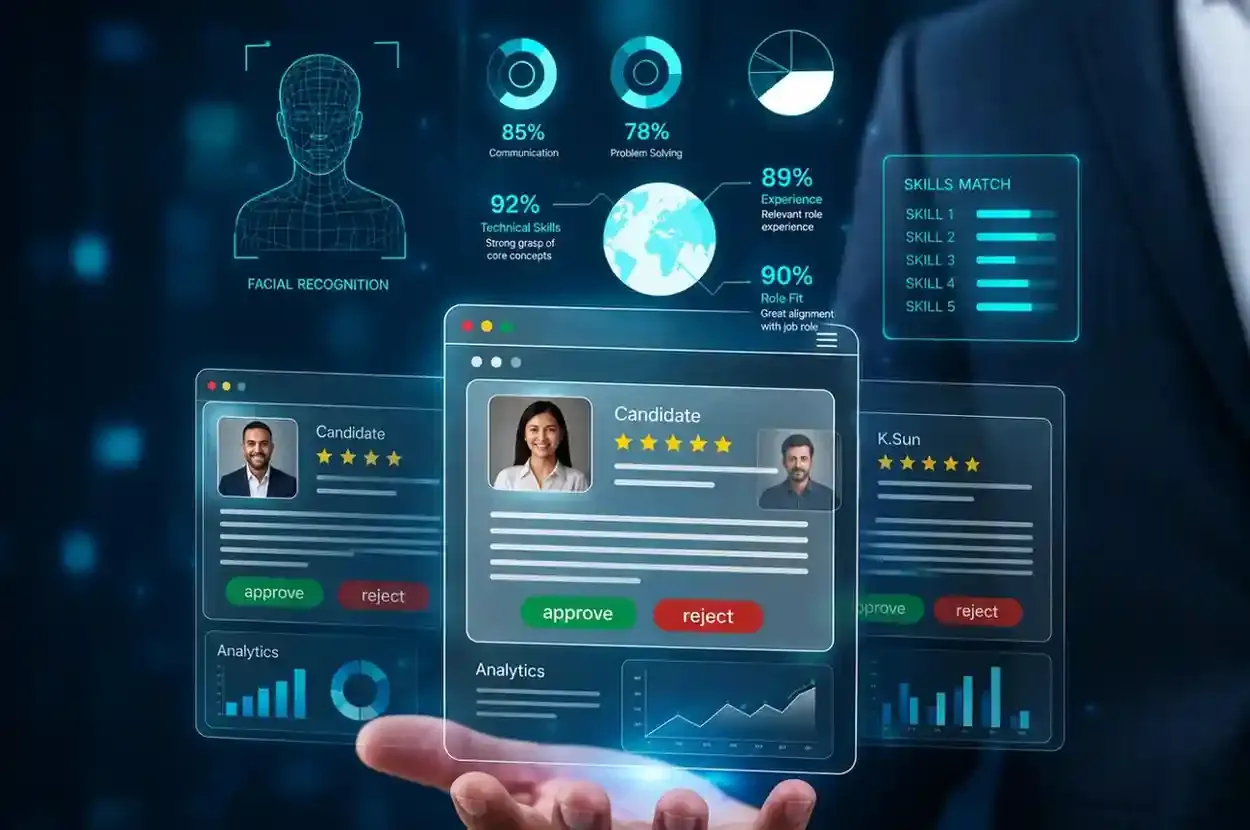
- The recruiter gets a scorecard: Score, evidence, skill-mapping and a recommended next step, reviewed by a person before anyone moves forward or gets screened out.
What Does AI Interview Scoring Actually Evaluate?
Role-specific Competency Alignment
Whether the response actually demonstrates the skill or behavior the question was designed to test, measured against criteria pulled from the job description, not a generic template applied to every role.
Skill Mapping
Rather than one aggregate number, the response gets mapped against each individual skill listed in the job description. As a result, a recruiter can see exactly which required skills were clearly demonstrated, which were not addressed at all, and which came up but stayed too shallow to be sure of.
Depth Beyond Delivery
A polished, confident answer that says nothing concrete should score lower than a rougher answer with real substance. Systems that generate context-aware follow-up questions are specifically built to catch the difference as a vague claim gets probed until there is an actual number, timeframe, or specific action behind it.
Reasoning and Structure
For behavioral questions, whether the candidate described a real situation, their specific role in it, the action they took, and a measurable result - the same logic behind the STAR framework, applied consistently rather than left to the interviewer's memory of how the answer flowed.
Consistency Between the Resume and the Interview
This is a signal a lot of AI interviewing tools skip entirely: comparing what a candidate claimed on their resume against what they actually say once they are being asked to explain it. Overstatements and alignment gaps surface here and so do genuine strengths a resume undersold.
Communication Clarity
Whether the answer is organized and addresses the actual question, flagged separately from content quality so a rambling answer with a good idea buried in it doesn't score identically to a sharp, direct one.
Integrity and Behavioral Signals
Facial cues, activity patterns, and inconsistencies during the session are monitored to flag potential AI-assisted or coached responses. A well-built system doesn't just raise a flag but also attaches a probability score showing how confident it is that something is actually off, a timestamp marking exactly where in the interview it happened, and reasons behind the flag. It serves as a signal for a recruiter to review, not grounds for automatic rejection.
What well-designed AI interview software and the best AI recruitment software deliberately avoid weighting: accent, video quality, background, and appearance.
What are the Main Types of AI Interview Scoring Systems?
Not every AI interview software scores interviews the same way. Four models cover most of what is on the market:
- Asynchronous (one-way) scoring: Candidates record responses to pre-set questions on their own schedule. The AI scores each answer after submission. Ideal for high-volume roles where live-scheduling dozens of interviews is not realistic.
- Live-interview augmentation: A human still runs the interview, live or in person. The AI transcribes in the background and generates a structured, competency-based scorecard afterward. The interviewer is not replaced but supported.
- Fully automated AI interview agents. No human is present. The AI asks questions, generates follow-ups based on the candidate's actual answers, and scores the full session. This is the most common for first-round, high-volume screening.
- Technical and coding-specific scoring. For engineering and data roles, evaluation extends past whether code runs. It covers problem-solving approach, edge-case handling, and whether the candidate can explain their own reasoning under follow-up.
AI Interview Scoring vs. Manual Interview Evaluation
Parameter | AI Interview Scoring | Manual Interview Evaluation |
Scheduling | No slot conflicts — candidates complete it independently, any time | Needs a mutual slot across candidate, interviewer, and often a panel |
Consistency | Same criteria applied to every candidate | Varies by interviewer, time of day, and fatigue |
Evidence | Score is tied to specific transcript evidence | Relies on notes and memory |
Scale | Can run dozens of interviews simultaneously, 24/7 | Limited by interviewer calendars |
Specialist depth | Applies the same specialist-level rubric regardless of who is running the process | Quality depends on whether that specific interviewer has real expertise in the role |
Auditability | Full record of every score and its rationale | Difficult to reconstruct after the fact |
Nuance | Weaker at reading interpersonal dynamics and cultural fit | Stronger at reading nuance and context |
Accountability | Requires a named human to own the final call | Accountability is built into the process by default |
Panel visibility | Every panelist can review prior scorecards and responses before their own round | Later rounds usually rely on a brief verbal handoff, with little detail carried forward |
The strongest hiring processes use AI interview scoring to handle volume and consistency at the early stages, then lean on human interviewing for the judgment calls: cultural fit, seniority-level nuance, and anything with real weight riding on the outcome.
Is AI Interview Scoring Fair? Bias, Compliance, Human Oversight
Where AI Interview Scoring Reduces Bias
Human interviewers are susceptible to affinity bias (favoring candidates who remind them of themselves), halo effects (one strong answer coloring the whole impression), and plain inconsistency from fatigue.
Applying the same criteria to every candidate, in the same order, removes those specific distortions. Also, evaluating primarily on transcript content rather than delivery, tone, or appearance removes another layer of bias that has nothing to do with job performance.
Where AI Interview Scoring Creates Risks
A model trained on narrow or historically skewed hiring data can encode those same patterns and apply them at scale. Language patterns tied to dialect or cultural communication style can also get misread as weaker responses, even when the underlying competency is demonstrated clearly. The risk doesn't disappear with AI, but it changes shape.
What Responsible Implementation of AI Interview Software Requires
- Scoring weighted toward transcript content, not appearance or vocal tone
- Independent bias audits checking whether outcomes vary by demographic group
- A human who can review and override every score, with no auto-rejection
- Clear disclosure to candidates that AI is involved and what it evaluates
- A full audit trail for every score, kept for as long as compliance requires
How Talentpool's AI Interviewer Handles AI Interview Scoring
Talentpool's AI Interviewer runs first-round interviews automatically, 24/7, for multiple candidates at once - no scheduling coordination, no back-and-forth emails to find a slot. It is a fully automated AI interview system inside our end-to-end recruitment software, designed specifically for the high-volume, early-stage screening round.
Here’s why Talentpool recruitment software stands out in interview intelligence:
- Questions come from the job description's non-negotiable skills and specific competencies.
- Question patterns can be set per role: case-study-based, scenario-based, or straightforward Q&A. So, the format actually fits what the role needs to test.
- Follow-ups are generated from the candidate's actual answer to understand how much, over what period, and what their specific contribution was behind a claim.
- Resume claims get checked against interview responses, surfacing alignment gaps, overstatements, and verified strengths.
- Integrity signals are monitored without invasive methods like gaze tracking or forced app installs.
- Every interview produces a structured, competency-based scorecard with a full audit trail.
- Recruiters keep final authority, as the AI Interviewer doesn't auto-reject anyone.
Is your team screening at volume, or do first-round interviews seem to be the bottleneck? Book a free demo to see how Talentpool's AI Interviewer solves it for you.
Key Takeaways
- AI interview scoring evaluates what a candidate says in an interview against job-specific competencies. It is a different tool from resume or candidate scoring, which ranks people before they are interviewed at all.
- The mechanism is consistent across serious platforms: capture, transcribe, score against a rubric, generate evidence, and human review.
- It is designed for high-volume, early-stage screening. Final hiring decisions still benefit from human judgment.
- Fairness comes down to three things: rubric quality, training data, and whether a human can review and override every score.
- Every credible platform produces an audit trail that includes the score plus the evidence behind it, which matters for hiring manager trust and for compliance.
- Recruiters adopt it to cut repetitive first-round screening time and apply one consistent standard to every candidate, not to automate the final call.
Frequently Asked Questions
Tags
Ankita Gupta
Marketing Specialist
Ankita Gupta is a key member of the Talentpool team, bringing extensive experience in talent acquisition and recruitment technology to help companies build better hiring processes.