
What is Passive Candidate Recruitment? A Complete Guide
Every recruiting team has hundreds of good candidates sitting cold in their database. This guide covers all about passive candidate recruitment strategies. Learn how to attract and source passive talent that isn't actively job hunting, how to engage them, and convert them into successful hires.

Sanchita Paul
Marketing Communication Specialist

Most of the people who'd be great at the job you're trying to fill aren't looking for a job at all.
They're not on Naukri. They're not scrolling on job boards. They're sitting in a role somewhere else, doing solid work, not thinking about job switching, until someone reaches out with the right opportunity at the right moment.
That's the entire premise of passive candidate recruitment: instead of waiting for the best people to apply, you find them. This guide covers what passive candidates actually are, how passive recruiting differs from active recruiting as part of a broader talent acquisition strategy, and exactly how to build a passive candidate pipeline.
What is a Passive Candidate?
A passive candidate is a currently employed professional who isn't actively job searching but would consider a new role if approached with the right opportunity. Unlike an active job seeker, they haven't applied, updated a resume, or signaled "open to work". Recruiters have to find and approach them first through sourcing, not job postings.
Passive candidates usually have:
- A stable current job, often one they're doing well in
- Skills or experience that are in short supply
- No urgency to move, meaning your outreach has to earn their attention, not just their application
Passive candidates sit on a spectrum, not in a single bucket. Some are "slightly open" (they'd glance at a message from the right company). Others are effectively unreachable until something changes in their current job. Recognizing where a candidate falls on that spectrum should shape how and how hard you pursue them.
Passive vs. Active Candidates - What's the Real Difference?
Factor | Active Candidates | Passive Candidates |
Job search status | Actively applying, updating profiles, searching boards | Not searching; may not have updated a resume in years |
Who initiates contact | Candidate applies to you | You initiate contact |
Motivation to move | Often has urgency (unemployed, unhappy, relocating) | Little to no urgency and needs a reason to consider change |
Competing offers | May be interviewing elsewhere simultaneously | Usually, not comparing multiple offers |
Decision timeline | Days to a few weeks | Weeks to months |
What convinces them | Job fit, compensation, timeline | Career growth, culture, timing, and personal connection |
Recruiter's role | Evaluate and select | Sell the opportunity and build trust first |
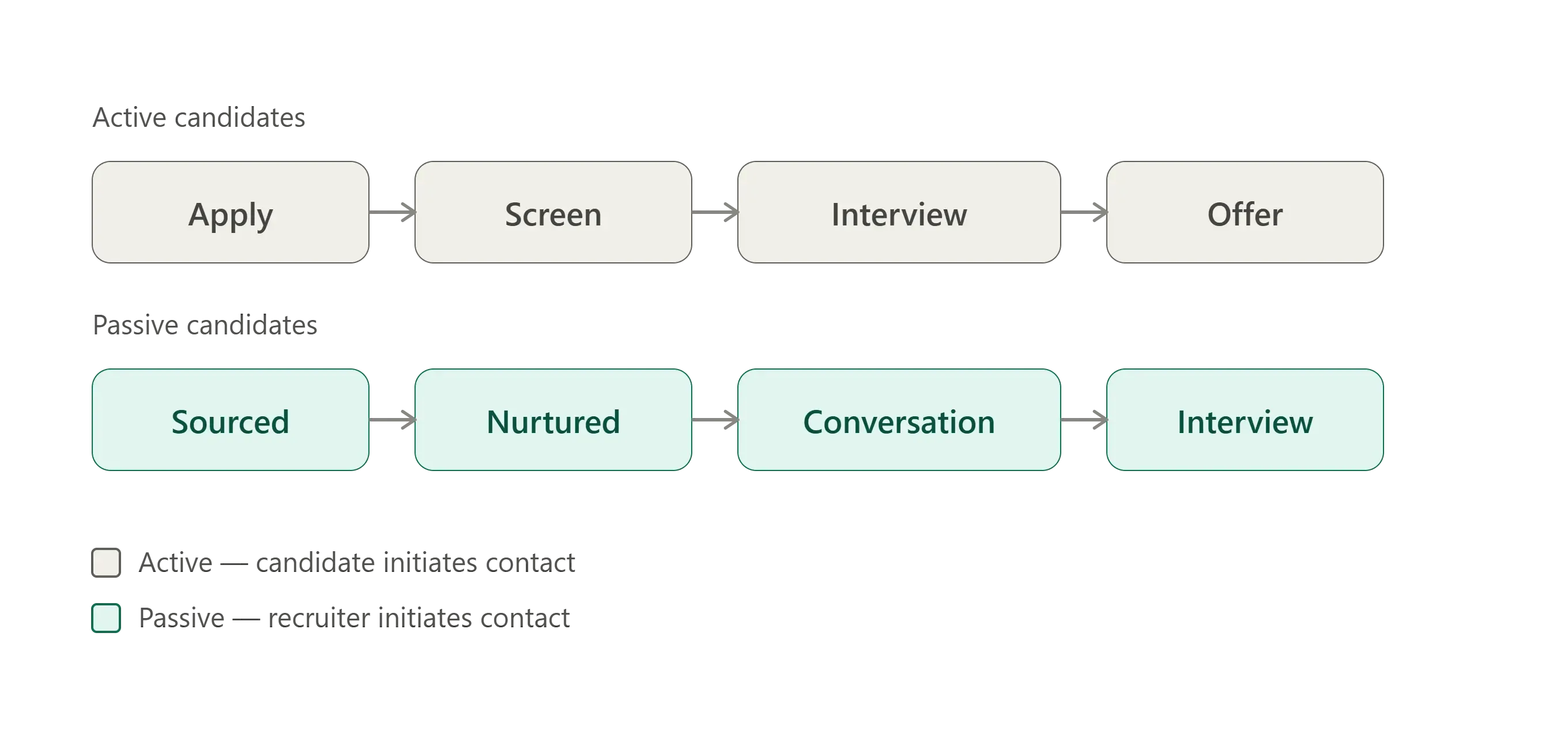
The practical takeaway: active recruiting is a filtering problem. You have plenty of applicants and need to find the right one. Passive recruiting is a persuasion problem. You've already identified the right person and now need to earn a conversation.
Why Passive Candidate Recruitment Matters
LinkedIn Talent Solutions research shows that only 36% of workers are actively looking for new roles at any given time, meaning the rest of the workforce falls into passive-candidate territory. Passive recruiting matters for three concrete reasons:
1. You Get to the Best People Before They're on the Market
By the time a strong candidate is actively applying, they're often already talking to three or four other companies. Reaching them before that happens means less competition and more negotiating room for both sides.
2. It Builds a Pipeline for Roles You Haven't Opened Yet
Candidate sourcing isn't just for the requisition in front of you. Every passive candidate you engage, even one who says "not right now", becomes part of a warm pipeline for future openings, which shortens time-to-fill months down the line.
3. It's Often the Only Path for Scarce or Senior Roles
For niche technical skills, leadership positions, or roles in industries with a small talent pool, there may simply not be enough active applicants to choose from. Passive sourcing isn't optional here, but the primary channel.
In tight labor markets, what's often called the "war for talent", the companies winning key hires are the ones running a consistent passive sourcing strategy that reaches people before a role ever gets publicly posted.
Also Read: How to Source Quality Candidates in a Competitive and Shrinking Talent Market
When is Passive Sourcing Worth the Investment?
Passive sourcing is worth the investment for scarce skills, senior roles, and business-critical positions where a wrong or slow hire is costly. It's usually not worth it for high-volume roles with a healthy applicant pool, where active sourcing and a strong ATS pipeline are more efficient.
Passive recruiting takes more recruiter time per hire than posting a job and screening applicants. It's not the right approach for every requisition. Use this quick framework before committing resources to it.
Lean into Passive Sourcing When
- The role requires scarce, specialized, or senior-level skills
- Past postings for this role got few or low-quality applicants
- The position is business-critical, and a slow, wrong hire is costly
- You're building a long-term pipeline (leadership bench, hard-to-fill technical tracks)
- Competitors are known to be hiring for the same profile
Stick with Active Sourcing When
- The role is high-volume or has a large, healthy applicant pool
- Time-to-fill is the primary constraint, and the role isn't highly specialized
- Budget or recruiter capacity doesn't support a longer, relationship-based process
A useful rule of thumb is if a requisition has gone unfilled through two or more posting cycles, or if the last three hires for that role came through referrals rather than applications, that's a strong signal to shift toward passive sourcing.
How to Build a Passive Candidate Pipeline
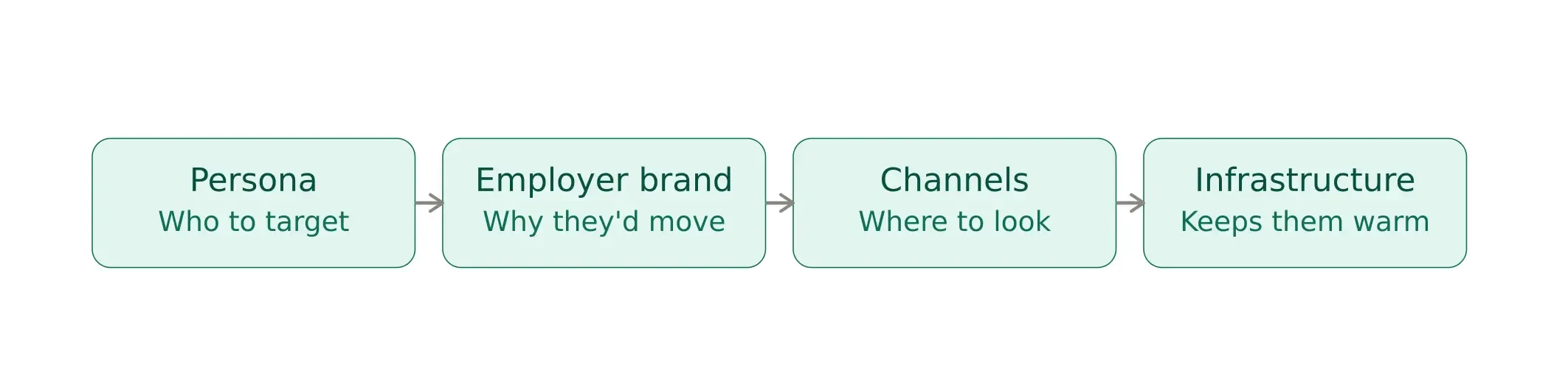
Building a strong passive talent pipeline comes down to four things: knowing who you're looking for, making your company worth considering, finding those people, and having a system that doesn't let good candidates fall through the cracks.
Step 1: Define Who You're Actually Looking For
Before sourcing anything, get specific about the profile. A vague target ("senior engineer with good communication skills") wastes hours of search time on the wrong people. A useful candidate profile includes:
- Core skills and experience that are non-negotiable vs. nice-to-have
- The job titles and company types this person likely holds today
- Career stage and likely motivators (growth, compensation, flexibility, stability)
- Where they're likely to be active online (LinkedIn, GitHub, niche communities, conferences)
Pull this from the hiring manager, from your best current performers in similar roles, and from your own database of past applicants for comparable positions. That history often tells you more than a job description does.
Step 2: Make Your Employer Brand Worth Discovering
Passive candidates evaluate you on the basis of whether it's even worth leaving where they are.
That decision usually happens before they ever talk to a recruiter, based on what they find when they look you up. This is your employee value proposition (EVP) at work, whether or not you've formally defined one: the mix of growth, culture, compensation, and flexibility that makes your company worth considering.
- Practical, low-effort ways to strengthen this:
- Keep your careers page current with real project details, not generic mission statements
- Publish employee stories and day-in-the-life content on LinkedIn, as candidates check these before responding to outreach
- Make sure your Glassdoor/LinkedIn presence reflects reality; passive candidates will check both
- Ensure the first message a candidate gets matches what they see on your public pages - inconsistency kills trust fast
Also Read: How Candidate Experience Impacts Your Glassdoor Reviews (and What to Do About It)
Step 3: Choose the Right Sourcing Channels
No single channel finds every passive candidate. Most passive candidate sourcing programs run two or three of these in parallel.
Channel | Best for | Effort | Notes |
Your existing candidate database | Fast re-engagement of pre-vetted people | Low | Often, the most underused channel. Past applicants and silver medalists already know your company |
LinkedIn / professional networks | Targeted, skill-based searches | Medium | Boolean search strings and X-ray search (Google-based profile search) improve precision; best ROI for white-collar and technical roles |
Employee referrals | High-trust introductions | Low–Medium | Referred candidates convert faster and stay longer |
Vendor/staffing partners | Scaling sourcing without adding headcount | Medium | Useful when internal capacity is the bottleneck; overlaps with headhunting/executive search for senior roles |
Industry events and talent communities | Senior, niche, or hard-to-Google roles | High | Slower, but builds relationships that convert months later |
Alumni and former contractors | Known quantities with proven fit | Low | Frequently skipped, despite being low-risk, high-signal |
Every recruiting team accumulates hundreds or thousands of candidates who applied before, were referred, or were sourced and never converted. Most of that talent goes cold simply because there's no system prompting anyone to revisit it. This is where Talentpool AI hiring software earns its keep.
Instead of resumes scattered across inboxes, spreadsheets, and old email threads, Talentpool gives every recruiter one centralized candidate database management system that past applicants, referrals, and sourced profiles all flow into automatically, so nothing sourced once is ever really lost.
From there, three features turn that database from a static archive into a live sourcing channel:
- Advanced search with saveable filters: Search by skill, location, past selection stage, or keyword relevance, and save the filter combinations you use often.
- Position sets: Group strong candidates into a role-specific reserve talent bench ahead of need. Rather than sourcing from zero every time, recruiters already have a shortlist of previously vetted candidates tagged and ready against that position type.
- Candidate module: In the candidate module, candidates can update their own resume once they're out of an active process, so the profiles sitting in your database stay current on their own.
Want to see how it can help you source passive candidates? Schedule a free 1:1 demo.
Step 4: Build the Infrastructure That Keeps Sourcing Active
Manual passive sourcing breaks down at scale for a predictable reason: recruiters find good people, contact a few, and then lose track of the rest because there's no system holding the pipeline together.
An applicant tracking system (ATS) alone cannot fix this. You need an end-to-end recruitment software with:
- Resume parsing and bulk import: Candidates sourced from LinkedIn, referrals, or events get into the database with structured, searchable data instead of sitting in an inbox
- AI scoring or recommendation tools: AI scoring helps in objectively ranking a large candidate pool against a specific job's requirements, so recruiter time goes to the strongest matches first, rather than a manual read-through
- Candidate relationship tracking: Every touchpoint (a message sent, a call held, a "not now, check back in 6 months") is logged and visible
- Reminders and follow-up scheduling: Passive recruiting is a long game; candidates who said no in March are often ready by September, but only if someone remembers to ask
How to Attract and Engage Passive Candidates
Get the First Message Right
A generic InMail gets ignored, or worse, makes the company look lazy. An effective first message does three things in under 100 words:
- Shows you did the homework: Reference something specific about their background, not a copy-pasted line
- Leads with relevance, not the job title: Explain why their specific experience matches what you're building, before pitching the role
- Makes responding low effort: Ask a simple yes/no question ("Open to a quick chat this week?") rather than asking them to read a full job description first
Sample first-touch message
Hi [Name], I came across your work on [specific project/skill], and it's exactly the kind of experience we need for a [role] we're building out at [Company]. I'm not sure if you're open to a conversation, but if you are, I'd love 15 minutes to share what we're working on. No pressure either way - happy to stay in touch if the timing isn't right.
Expect a Longer Cycle, and Plan for It
Passive candidates typically need multiple touchpoints before they'll consider a move seriously. A realistic sequence looks like:
- Initial outreach: Personalized, low-commitment
- Follow-up with value: An article, an intro to a team member, something useful, not just "checking in"
- A real conversation: Informal, on the candidate's schedule, focused on their goals before pitching yours
- A concrete opportunity: Only once there's genuine interest, move to a formal process
Two or three unanswered follow-ups are usually the signal to stop and move the person into a long-term nurture campaign.
Respect That They're Still Employed
Passive candidates are often discreet about exploring options. Small accommodations go a long way:
- Offer calls outside standard working hours
- Avoid contacting them on their current work email or number unless they've provided it
- Don't rush straight to a formal interview - a casual conversation first lowers the stakes
Sell the Move, Not Just the Job
An active candidate is comparing job descriptions. A passive candidate is comparing their current, stable situation against the unknown. That means the conversation has to address:
- What growth or scope would they gain that they don't have today
- Why now is a good time to make a move, specifically
- What the company is actually like to work at - day to day, not the brochure version
Measuring Passive Recruiting Success
The core metrics for passive recruiting are
Metric | What does it tell you |
Sourced-candidate response rate | Whether your outreach messaging and targeting are working |
Sourced-to-interview conversion | Whether the people you're finding are actually qualified |
Time from first contact to offer | Realistic passive-hire timelines, for planning purposes |
Re-engagement rate (database) | How much value are you getting from your existing candidate pool |
Quality of hire/retention at 12 months | Whether passive hires perform and stay, often the strongest case for the extra effort |
Track these separately from active-channel metrics like cost per hire, since passive pipelines pay off over a longer timeline.
Common Mistakes in Passive Candidate Recruitment
Treating passive outreach like a job posting: Sending the full job description in the first message reads as impersonal and puts the burden of interest on the candidate instead of the recruiter.
- Giving up after one message: Passive candidates rarely respond to a first touch. Teams that stop after one attempt are leaving most of the channel's value on the table.
- Letting sourced candidates go cold: Finding a great passive candidate and then having no system to follow up in three or six months wastes the original sourcing effort entirely.
- Ignoring the existing database: Teams often build new sourcing lists from scratch while hundreds of qualified, previously-sourced candidates sit untouched in the ATS software.
- Applying the same urgency as active recruiting: Pushing a passive candidate toward a fast decision usually backfires since they didn't come to you with urgency, and manufacturing it feels like pressure, not opportunity.
- Skipping the employer brand groundwork: Outreach fails more often because of what a candidate finds when they check the company out afterward than because of the message itself.
Also Read: 7 Ways to Boost Your Employer Brand
Key Takeaways
- A passive candidate is currently employed, not job hunting, but open to the right opportunity, and this changes who initiates contact and how long the process takes.
- Passive recruiting is a persuasion problem, not a filtering problem; active recruiting is the reverse.
- Not every role justifies passive sourcing. So, reserve it for scarce skills, senior positions, or roles where past active postings underperformed.
- First-touch outreach should be short, specific, and low-pressure. Expect multiple touchpoints before a response.
- Passive sourcing needs its own KPIs (response rate, conversion, retention) rather than being measured against active-channel speed.
Frequently Asked Questions
Tags
Sanchita Paul
Marketing Communication Specialist
Sanchita Paul is a key member of the Talentpool team, bringing extensive experience in talent acquisition and recruitment technology to help companies build better hiring processes.